

Description
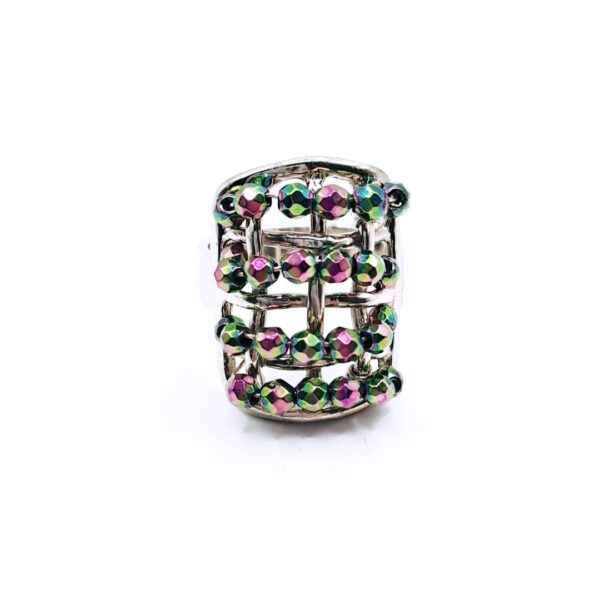
Skein ring.
Sterling silver 925, platinum-plated.
Handmade silver ring wrapped with peridot, agate and carnelian, from the Skein series.
1) Peridot is a transparent mineral with the green colour of olive oil. Its name may come from the Persian word faridat, meaning precious stone.
Peridot has been known since antiquity. The Egyptians mined peridot on the island of Zabargad in the Red Sea, and these mines were worked until 1920.
It was also known in ancient Greece, where it was called topaz. The Romans knew and used peridot, which they called the “emerald of the night”.
Peridot is the gem-quality form of olivine (sometimes also called chrysolite), a fairly widespread mineral. Even so, it is quite rare in olivine deposits.
It is one of the few precious stones that always occur in a single colour, which becomes more intense the more iron is present as an impurity in its mass.
The largest quantity of peridot is mined in Arizona, USA, but it is of relatively low quality. In Pakistan, in a remote area on the border with Afghanistan, there are mines of exceptional quality peridot. That is where the peridot traded worldwide for fine jewellery comes from.
A large piece of peridot adorns the Shrine of the Three Kings in Cologne Cathedral.
Today peridot is in steady demand in jewellery making, for its unique colour and its other qualities, which make it a popular precious stone.
2) Agate belongs to the tectosilicate minerals. It is considered one of the varieties of chalcedony (a microcrystalline form of quartz) and occurs in various colours, white being the most common. In all its colours, however, it is translucent.
According to Theophrastus, the Greeks named this mineral after the river Achates (today the Drilio) in Sicily, where it was found.
Agate was highly prized as an amulet in antiquity. Agate cups were also very popular in the Byzantine Empire and, during the Renaissance, among the aristocrats of the time.
3) Carnelian (or cornelian) is a reddish-brown mineral, usually used as a semi-precious stone. It is a variety of chalcedony, a mineral containing silicon dioxide, coloured by iron oxide.
The colour of carnelian varies widely, from light orange to deep, almost black.
Carnelian has been found in the Minoan Bronze Age layers at Knossos in Crete, in a form that shows it was used in the decorative arts (1800 BC).
Carnelian was widely used in Roman times to make engraved gems for signet rings, which were used to press a seal into wax on correspondence.
The term carnelian is a 16th-century corruption of the 14th-century word cornelian.
The word cornelian comes from the medieval Latin “corneolus”, which in turn came from the Latin word “cornum”, the cornel tree, a kind of wild cherry whose almost translucent red fruit resembles this stone.
Carnelian is considered a stone of self-respect and self-confidence.
*All our jewellery comes with a certificate of quality and authenticity for the metal and the precious or semi-precious stones.
*All our jewellery is nickel free.